
You need all the layers~5 min read
Buenos Bakery, by hand
The first thing we ever built was a website for a bakery. It worked. Then we tried to do it again - and the wall was us.

Chapter guide 3 chapters
01 / The first build
Buenos Bakery, by hand
The first thing we ever built was a website for a bakery.
Nothing about it was ambitious. A small product for a local business - the kind of thing you would expect one developer to knock out in a couple of weeks. I built it in Windsurf, an AI-powered editor, and for the first time in fifteen years of writing software, I was not really typing the code. I was describing what I wanted, watching the editor write it, reading what came back, and deciding whether it was right.
I have fifteen years in engineering, six of them as an engineering manager. I know what good looks like - not as a feeling, but as a checklist. Linting that actually runs. Tests that mean something. A folder structure you can navigate at 2am. Files small enough that a human - or, it turns out, a machine - can hold one in their head. So when the AI handed me code, I did not just accept it. I reviewed it the way I would review a junior's pull request: line by line, does this belong here, is this the right shape, will this rot in three months.
And it worked. Buenos Bakery got built. The AI was fast, I was careful, and between us the thing shipped. It genuinely felt like magic - the first time the machine wrote something non-trivial and correct, I remember thinking the job had just changed permanently.
Then I tried to do it again. And again. And the magic ran into a wall, and the wall was me.
Here is the problem nobody warns you about. When one AI writes code in one editor, you are the reviewer, the integrator, and the quality gate - all of it, all at once, in a single window looking at a single project. The AI got faster the more I used it. I did not. I was still reading every diff, still holding the whole project in my head, still the one saying yes or no to each change. One window, one project, one human bottleneck.
That is fine if you are focused on one thing at a time. But when you realize the only thing stopping you from moving faster is you, something shifts. You want to deliver more. I did not want to build one app well. I wanted to build the way a team of twenty builds, except the team was me and a growing pile of AI. And the editor-shaped setup I had could not do that, for a reason that took me embarrassingly long to name:
I had made the AI faster at writing code without making myself faster at everything around it.
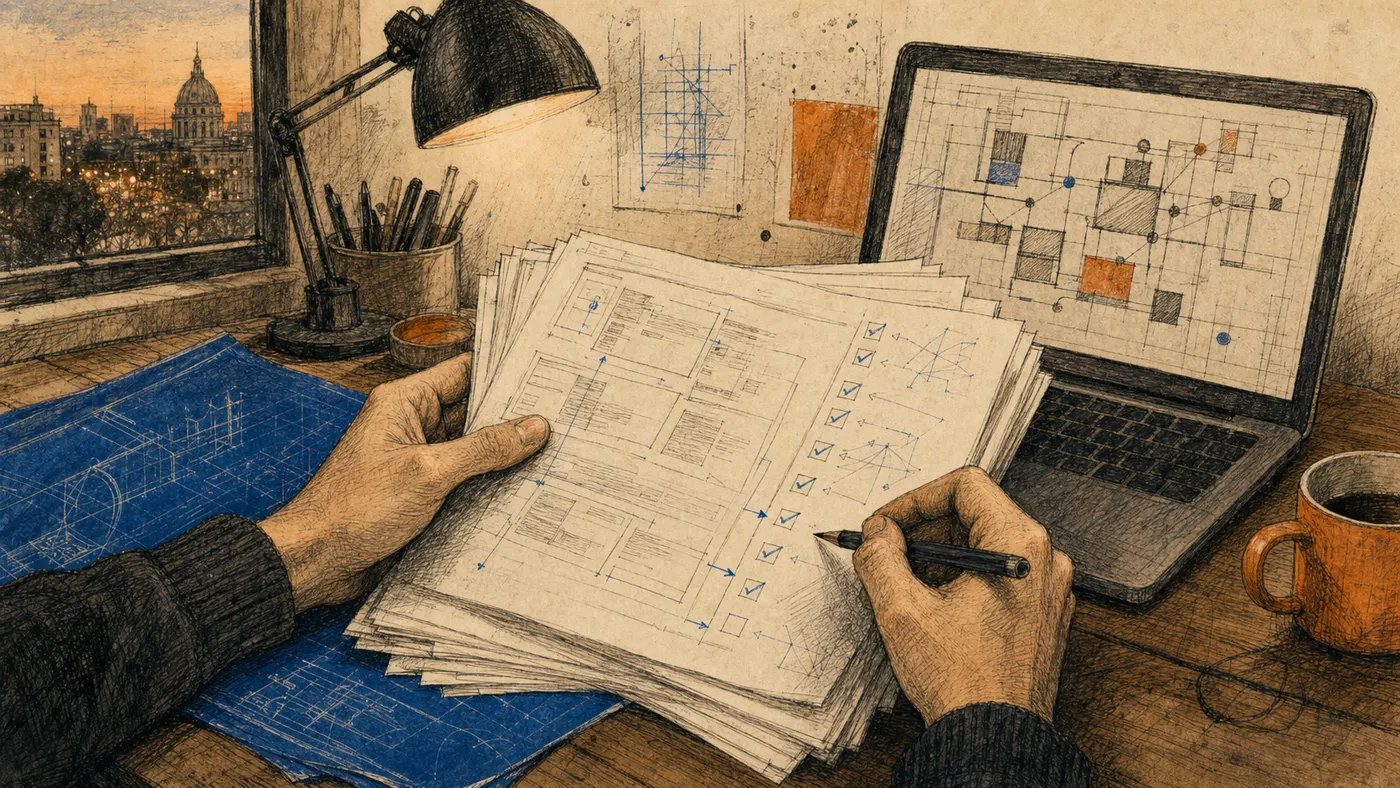
02 / The bottleneck
More code. Still one gate.
Reviewing, integrating, deciding, remembering what happened yesterday, keeping five projects straight - none of that got easier because the code appeared quicker. If anything it got harder, because now there was more code, arriving faster, and still exactly one me to catch it. The bottleneck had just moved from "typing" to "everything that is not typing," and that part does not have a Windsurf button.
This is where the story actually starts. The drones, the Docker containers, the fleet merging seventy times a day - that is how it ends, and we will get there. But it begins small: a bakery website, and one uncomfortable thought I could not shake.
If I keep working like this, the AI's speed is wasted, because I am the slow part - and I always will be.
03 / The layers
The next problem was not a tool
Everything that came after was an attempt to fix that one problem. Not "make the AI smarter." Make the organization around the AI real - so the machine could write, review, integrate, remember, coordinate, and ship without me standing in the middle of every single step. It turns out you cannot buy that in one piece. You build it in layers, and every layer teaches you why you needed the next one.
The first layer was not a tool at all. It was the thing I brought from fifteen years of managing engineers - a set of standards, written down before a single drone existed. That is where we go next.
Next chapter: the standards came first - why the very first thing we built was not code, but the rules the code had to obey.